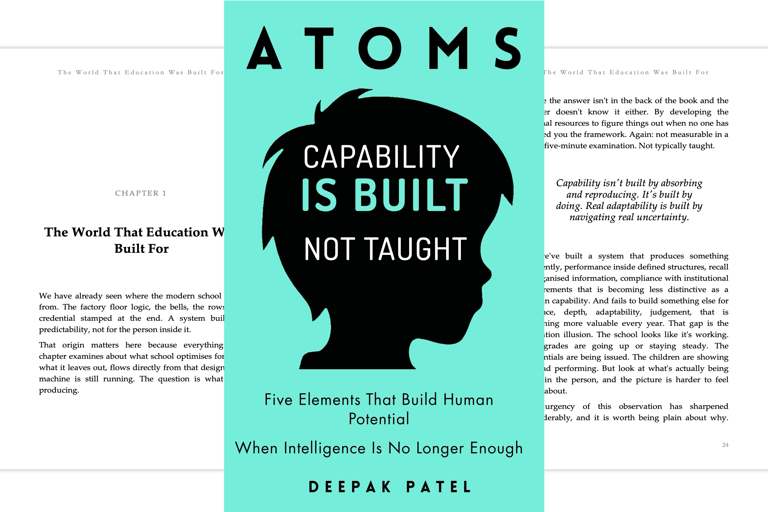


ATOMS
Five Elements That Build Human Potential
Aptitude . Tectonics . Orthodoxy . Mindset . Synthesis
THE MISSING CURRICULUM FOR LIFE


When Intelligence Is No Longer Enough
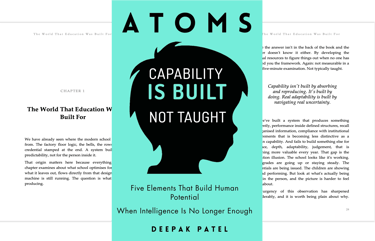
The education system that's built ages ago is good at producing one thing: people who can perform well inside it. The problem is the world outside it looks nothing like the world inside it.
ATOMS starts there, with that gap and tries to answer the question most education books dodge: what does it actually take to raise a person who can think clearly, build real things, and keep developing as the world changes around them?
The answer turns out to be five layers of development that have always been present in the people history judges as genuinely capable and almost entirely absent from how we currently design education.
ATOMS works through what those five layers are, how they interact, and how to build them deliberately in any child, in the environments you already have access to. It draws on three lives from history to show the pattern isn't theoretical. And it ends with something practical: questions you can actually use, and a way of thinking about the environments around a child that changes what you look for and what you do.
It's written for parents who sense something is missing but can't quite name it. And for educators who already know something is wrong but are working inside a system that wasn't designed to fix it.


DEEPAK PATEL
I am a parent first. I am not a scientist. I am not a researcher or an academic. I write to understand the world as it is, not as we were told it should be. Most of my work focuses on how we learn, how we think, and how we make decisions when everything feels like it’s moving too fast. I’m especially interested in the gap between what we’re taught and what actually helps in real life.
ATOMS grew out of something personal. It began with trying to design an education for my own children, looking at the system from the outside in and questioning what really matters and what doesn’t. It’s become a way of breaking down complex ideas into simple, practical frameworks that people can actually use, whether they’re students, teachers, or just trying to think more clearly in a noisy world.